
Can you trust the critics?
What the response to One Battle After Another, After the Hunt, and Sydney Sweeney's GQ interview teach us about the imperiled power of art in public life.


Halfway through Paul Thomas Anderson’s (PTA) newest film, I leaned over to my girlfriend to say, for the third time, “no, really, it’s okay — we can leave.”
“But you’re having fun.”
“No — I’m laughing because it’s so bad. I just don’t understand how this got 95 on metacritic.”
That part wasn’t exactly true. I did know why One Battle After Another got such a glazing — I just didn’t want to believe that it could be so damn unanimous. Despite being an utter letdown for this fan of There Will be Blood and The Master; despite looking on track to lose $100M; despite abandoning the core insight of the book on which it’s based, and despite crossing some fairly clear progressive lines in the process, the film will probably still end up sweeping the Oscars. Like the last two years’ elections, it’s the kind of shock where you ask yourself: am I the crazy one?
So I rented it out on Prime just to be sure. And no, I don’t think I’m the crazy one. While the film is technically successful and decently entertaining, it fails as an adaptation and ultimately fails more profoundly as a story. I’ll argue that redemption on these counts depends upon whether the film’s political excesses were intended to elicit the unanimously uncritical mob-reception they’ve received, or whether these excesses are just playful pieces of ironic residue from Pynchon with no more demanding performative purpose.
The movie is only a success if the joke is on us. Implicating the critics in an ironic demonstration of the film’s core messages would be a gangster move by PTA though. To show us that we too could fall in with the French 75 if we’re not careful would be a real triumph. And so far, critics seem to have entirely ignored this possibility, so it’s not out of the question. But sadly, PTA’s actual public statements about the film don’t seem to support this interpretation, which is why I’m ultimately giving it a 7/10.
—
What do I mean by “political excesses,” and why are these ultimately a problem for One Battle when they aren’t for Pynchon’s Vineland from which it was inspired? To understand, it’s helpful to start with a brief synopsis of Vineland. Spoiler alerts!
First and foremost, Vineland is a novel that’s rooted in a particular time and place — California between the 60’s and 80’s. The story centers on Zoyd and Prairie Wheeler, a father and daughter evading federal drug enforcement agents. Prairie’s mother, a white woman named Frenesi, has gone underground. We later learn she was once part of a film collective that sought to document federal interference with a group of southern California hippies whose college had seceded from the union to form the People’s Republic of Rock and Roll. Frenesi falls in love with one of the federal agents, Brock, who is investigating the PR3 and ends up acting as a double-agent — eventually betraying the secessionist’s leader. Brock puts her in witness protection, which she eventually flees, setting up a chase that culminates in a melancholic family reunion with Brock dangling above from a DEA helicopter only to have the operation cancelled mid-flight because the Reagan government could declare victor in the war on drugs thanks to America’s lost interest in rebellion.
By contrast, in One Battle, we’re not really given a distinct temporal anchor. We get the vague sense that it begins in the 2000’s, near the Mexico border in Southern California. Zoyd and Frenesi are now Pat (Leo) and Perfidia (Taylor), readying a ragtag crew (the French 75) to forcibly liberate a nearby migrant detention center. We’re introduced to their ideology pretty immediately: “The message is clear: free borders, free bodies, free choices, and free from fuckin’ fear!” Perfidia announces when she apprehends the villain, Colonel Lockjaw (Penn). And as they’re triumphantly leaving, Pat shouts ““we are a political organization that is free from the eyes, the ears, and most importantly, the weapons of the imperialist state and this fascist regime!”
Predictably, what follows is a montage of terrorist bombings that she and Pat help orchestrate across the city where the curtain is pulled back even further on Perfidia’s politics. True to form, the French 75 aren’t just interested in immigration politics. They want the whole everything bagel. In one scene, Perfidia threatens a political leader via a payphone:
“Senator Wilson, this is a warning for you. We planted a bomb at the Haymarket office of your reelection campaign. We warned you that abortion ban, and you didn’t want to fucking listen. So, for my sisters in need, we will strike. Sincerely yours, Perfidia Beverly Hills motherfuckers.”
When Pat and Perfidia aren’t bombing, they’re banging. The film’s opening is gratuitously sexual, but that would be forgivable were it not for the fact that the sexuality is so racially coded. Power, for Perfidia, is portrayed primarily through sex and violence. PTA chose to make Frenesi into a violent Black revolutionary, and chose to make Lockjack pursue her rather than the other way around as in Vineland.
Nor is Perfidia the only Black woman in One Battle whose power is reduced to her appearance. Her partner in crime, Jungle Pussy (sigh, yes) gets a brief monologue while catwalking the teller’s counters in a bank robbery scene as the camera pans from below:
“This is what power looks like. I don’t want you, I just want your money. Your money pays for my artillery, my supplies, my transportation, my dynamite, my message. I am what Black power looks like. See my face? I’m the French 75.”
In moments like these, PTA seems to be asking us to embrace these character’s diminutive status by encouraging us to cheer them on. We’re distracted from recognizing their vulnerability and class exploitation because we’re too busy cheering yass. These are editorial decisions. The question is just whether they’re catnip, or bait.
—
Now to be fair, these are not totally one dimensional characters, and it’s not obvious that we’re meant to fully sympathize with them. Despite their roles in the action, Perfidia is a violent, self-centered, sex-addict who abandons her child and sells out her compatriots. Pat is a drugged-out, bumbling deadbeat who can barely take care of himself, let alone Willa. Colonel Lockjaw is less textured, but even he gets some hints of vulnerability (insistence he’s not gay, desperation to be in the Christmas Adventurer’s club, flickers of compassion for his daughter).
It’s also important to remember that One Battle was filmed and produced before the election in 2024 — so if the themes feel a bit too timely, that is in part because of how tragically off the rails US immigration enforcement has become in 2025. But even so, it’s difficult to imagine this film having the same kind of reception if released during, say, 2010 when the president deporting millions of illegal immigrants was a Democrat and the other Oscar contenders were A Serious Man, Precious, Avatar, The Hurt Locker, and Fantastic Mr. Fox. To be sure, films about left-wing political violence can succeed in telling a complicated story — PTA even references one in the film — but his attempt in One Battle just feels like it’s made for high schoolers: accessible, cheap, and dumb. PTA took a surreal, absurdist post-modern novel that criticized left and right illiberalism, and flattened it into a bit of pre-chewed, lopsided literalism that’s actually not that great for us — aesthetically, or politically.
Finally, PTA does use the screenplay to poke a fair amount of fun at the critical theoretic left’s faux-revolutionary rhetoric. When Pat is on the phone with a low-level French 75 staffer struggling to remember a password he needs to get some coordinates for a meetup, PTA turns the staffer into an exacting scold: “this is a key tenet of the rebellion text, I’m surprised you can’t name it!” And then as Pat grows increasingly irritated, escalates to: “okay, this doesn’t feel safe, you’re violating my space right now.” To which Pat replies “this is not how revolutionaries do shit! Do you know how hard you are to talk to? Do you know the information I am trying to give you? You’re a little nitpicking prick!” And when the cops go after Willa’s four friends to try and get her cell phone number, it’s the non-binary friend that rats her. Far from Pynchon’s absurdist irony that ultimately refuses to take sides, these nods by PTA feel more like throwaways to give critics plausible deniability that the film isn’t a total caricature.
And I’m not claiming that it is! I’m just claiming that PTA took an essentially complicated story about how the 1960’s cultural revolutionaries failed because they believed that they could fight the state with cameras and stories, and he turned it into a shallow action movie where good guys rob banks and the sexy Black revolutionary is powerful because she fucks the racist cop (out of prudential rather than erotic desire). And critics called it profound because it felt timely and confirmed their politics.
While the film doesn’t exactly glorify political violence, it is remarkably silent over the external conditions that could be taken as justifying it. It’s a movie in which the left-radicals are clearly The Good Guys, even if we see them kill an innocent security guard during a bank robbery and bomb public infrastructure. We aren’t told anything about the legal status of the immigrants either, so the law enforcement motives get completely flattened. Are these guys just working a job trying to uphold immigration law, or are they rounding up legal citizens in some kind of post-liberal dystopia? “Yes.” the chinstroker will reply, as if this is some damning indictment of the current political moment.
Even if we learn in passing that the migrants in Pat’s sanctuary city have been illegally smuggled there by the French 75, this doesn’t materially shift their portrayals. Nor could it. Maintenance of ambiguity over the migrants’ legal status is necessary because the film has to fit into the dogmatic poles of contemporary immigration politics. On the right, maintaining an ambiguity over legal status backstops a racist deportation regime that would prefer to prioritize ethnic appearance. On the left, maintaining an ambiguity is necessary for people who want to claim that there are not morally relevant distinctions across differences in legal status. “Free borders, free bodies, free choices, and free from fucking fear.” That’s Perfidia’s message, and eerily close to the DSA’s. Either way, the imprecision is necessary because it drives the characters’ feelings of superiority (moral or ethnic). If PTA had done more to explicitly poke at this ambiguity, it would have certainly made the film more interesting — but probably at the risk of popular intelligibility.
Given all this, it’s impossible to ignore the possibility that being overdone is actually part of the movie’s artistic point. Perhaps PTA knew that One Battle After Another would evoke precisely this kind of unanimous critical celebration in spite of its blindingly obvious core failures — and that this would thereby constitute the film’s final (and ultimately redemptive) message: “you too dear viewer, could fall in with the French 75 if you aren’t careful.” Based on interviews he’s given about the movie, and the narrative changes he made from Vineland, I think this is pretty unlikely, but it’s the only redeeming reading I can muster from it so I’ll stick with it. PTA’s adaptation is the triumph of Pynchon’s omnipresent Tube.
So there — we should regard the mob-mentality exhibited by reviewers as an extension of the film itself. Their unwavering inability to call this movie bad suggests that something else must be going on. And that’s ultimately the most interesting part about the film. It’s one thing to produce cultural work canonizing anti-liberal leftists. It’s quite another to do so in a way that actually perpetuates many of the same ills that its audience would normally be able to recognize as straightforwardly problematic were they not already caught in its spell. It’s textbook symbolic capitalism.
—
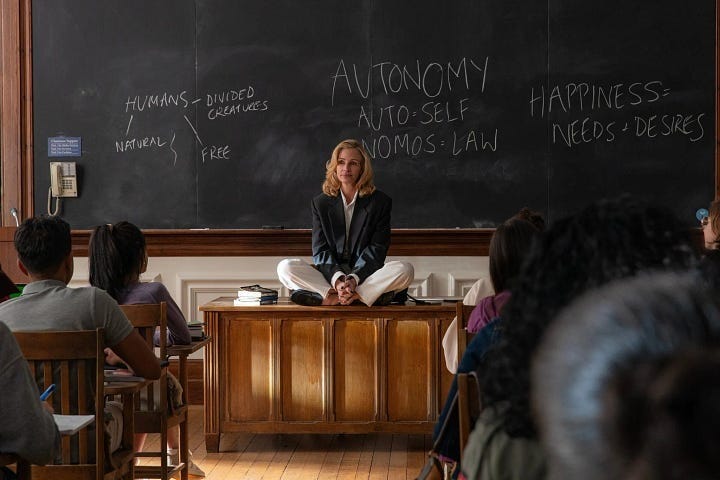
If the joke is on us the critical class for receiving One Battle with such mob-like hysteria, the joke is also on them for their schizophrenic reception to After the Hunt (52 on metacritic). While there’s no comparison between the two films technically or financially, After the Hunt is at least less predictable than One Battle. It subverts the received narratives and puts pressure on the viewer in ways that One Battle could only dream of. Freddie deBoer’s got an excellent review on his substack, so I won’t repeat his points. Suffice to say he makes a similar argument to the one I make above for One Battle — that the film is intended to bait its critics, but in the opposite direction. He says, “The movie, in effect, holds up a mirror to critics and thinkers who assume that those with moral language must have moral backbone.” And while I don’t think he’s wrong about that, per se, I do want to push on the idea that the philosophy faculty and graduate students in the film are actually equipped with “moral language.”
This was Nora Garrett’s first feature-length screenplay, and while it is fantastic it also seems to be the case that she is painfully ignorant of what philosophy actually is. So I don’t think she realized that the “people studying ethics behave just as badly as everyone else” trope would actually be complicated by the kind of ethics with which she chose to equip her characters. Unfortunately for her—but fortunately for those like me who believe in the power of education to improve moral reasoning—not all philosophy is made equal.
The philosophy she depicts in the script is actually a very particular kind of philosophy that is largely not practiced at Yale or even in what professional philosophers call “the Anglosphere” (UK, US, Australia, Canada). It’s Continental philosophy, the kind that actually gets more discussion in sociology and English departments in the US than in philosophy departments.
And for good reason! With the obligatory acknowledgment that there are some really good continental philosophers (Merleau-Ponty, Heidegger, Habermas) from the 20th century, much of the continental canon is not just utter garbage, but deeply problematic from an ethical standpoint. It’s the kind of philosophy where one could legitimately title a paper, “Metaphysical ethics in the Anthropocene: Sub-ontological human behavior, avatars, and the cotillion of the internet.” This is the real title for a paper that Alma (the main character) writes in the film, and it feels like it could have been pulled straight out of the infamously hilarious postmodern essay generator.
In an early seminar scene, Alma bursts into the room late to say, “we were discussing Foucault’s panopticon, where we’re conscripted to observe one another for missteps.” Foucault features pretty centrally in this continental canon. So often, in fact, that he appears on more on college syllabi than any other author. He was also (among other unsavory things) a notorious apologist for pedophilia. And this is the guy that Alma (the main character) is teaching! Not in a “beware the dogmas that lead to fascism” style either, but in a what can we learn from the great masters kind of way. If she and Hank and Maggie are getting their “ethics” from Foucault, we shouldn’t be at all surprised at their ability to warp that language to portray themselves as victims when the reality is actually far muddier. Indeed, Alma’s sympathy for this work turns out to be pretty ironic given the film’s central plot twist (which I won’t reveal).
It doesn’t really matter that Nora Garrett probably doesn’t realize this. If anything, it helps. Because the critics who make the same mistake she does probably also think that they got a good education in ethics from their sociology and English departments — that reading Marx, Foucault, Lyotard, Lacan, Derrida, Butler, McIntosh, and Bourdieu is really all you have to do to be woke. So if the people who teach those authors are depicted as morally inept because of the power they wield, all the better — that just confirms the core reductionist view common among all of them that facts about norms are actually just veiling facts about power relations.
But if you think there’s something actually quite normatively suspect about that reductionist view and the way it has been wielded by so many to putatively justify bad behavior, then there’s no real tension or surprise here. In one particularly apt seminar scene late in the film, Alma explodes at her students for misinterpreting the concept of “The Other” — demonstrating in the process how easily the rhetorical frameworks in this particular intellectual tradition can be warped to suit oneself.
I’ve not read a single review that attends to these actual differences in the kind of philosophy that’s featured in the film, but that doesn’t surprise me. It’s rare that the folks who go on to take a critic post at major magazines have familiarity with the breadth of the 20th century philosophical tradition. Were this just ignorance of a particular niche discipline featured in any film, that would be fine. But these are authors behind the ideas that shaped the critical turn in elite institutions. So the tragedy isn’t just their inability to see the irony and nuance in this film; it’s that they’re so deeply enmeshed in the therapeutic worldview defined by this intellectual tradition that they cannot conceive of procedural justice being imagined any other way.
What’s tragic about this is just how well it predicts the film’s reception. To talk only of motivated reasoning would be to risk understatement. Rolling Stone critic David Fear wrote that the film “feels downright offensive” (and gave it a 1/10). In Vanity Fair, Owen Gleiberman called the film, “a weirdly muddled experience — a tale that’s tense and compelling at times, but dotted with contrivances and too many vague unanswered questions. That’s why, in the end, it’s a less than satisfying movie.” It’s too bad, because when the script was making the rounds in 2024, it was actually getting a ton of praise. Apparently Luca decided it should be made a bit murkier, which was absolutely the right call — but the fact that critical reception shifted so dramatically once it was actually produced just goes to show how tightly the critics have circled their wagons to protect their ideology from the onslaughts of our Vibeshift.
Garrett nods to the Vibeshift at the end of the film, when we flash forward five years and Alma is split screening between an email and a news broadcast of the LA wildfires that segways into a brief on Meta’s policy shift to allow more hate speech on the platform — something to which she and I both had front row seats working for the company. While I won’t elaborate I will say that here, as in the film, the reality is far more complex.
I also had a front row seat to an actual case of sexual harassment allegations in a philosophy department between a student and a powerful professor. In fact, the most-cited professor in the discipline! And while the story wasn’t without its complexities, the University’s formal judicial process did work. This philosopher was put on administrative leave, revoked his emeritus title, and did not teach in the department again. Real justice may sometimes be messy. It may sometimes involve contingency and power. But contra the critical theorists, recognizing these facts need not spoil the possibility that it can still be achieved through transparent, fair, procedural, and rule-based methods. I give After the Hunt an 8/10. Screenplay, cinematography, acting, and directing are all excellent. Plot certainly beats One Battle. The only things I found lacking were humor and, in the visuals, color.
—

The critical class’s motivated reasoning was also on full display in the recent Discourse™ around Sydney Sweeney’s recent GQ interview where she gave some answers to her questions about her American Eagle jeans ad that didn’t quite seem to satisfy her interviewer, Katherine Stoeffel, or the critics — left and right! — who insisted on endlessly dissecting the moment afterwards.
But what if her answers in this interview weren’t some kind of defiant political stunt? What if Sweeney really did just do a jeans ad? What if she has the self-confidence to hold fast to that belief without the need to play status games when invited by Stoeffel? Or what if the joke was that, yes, she had good genes but also when looked at in the context of American Eagle’s other marketing that quarter, Beyonce could have just as well been featured? It’s pretty non-controversial to assert that beautiful people have good genes, and it’s probably pretty uncontroversial to believe some genes are better than others (e.g. if you believe siblings should not procreate, you’re probably a eugenicist).
And what if instead of being smug, dismissive, and snide, Kat Stoeffel was actually just making those faces because she was, I don’t know, a little nervous to be interviewing a woman so profoundly not her status equal?
The saddest part about the interview is that Sweeney was on the show to promote her damn movie! A true-life story about Christy Martin, one of the best female boxers of all time and a domestic violence survivor from a working class background. It’s a good story about women’s strength, poverty, fallenness, and redemption. And what did the critical class do? They made the whole story about this one particular exchange around jeans. If you’re Sweeney and you want to get the word out about your film, what do you make of this?
As the real-life Yale philosopher Jason Stanley would say: “Is that success?” No “It isn’t success.”
—
Critics play a vital role in our culture. I want them to succeed, and I want more of them. But they need to individuate and resist getting swept up in the frothing tides of the Take Machine. Individuation in this moment doesn’t require transcending politics, but it does require having a sense of Things That Matter beyond them. First off, it takes courage to write from a position that gives “not-threatened.” Nearly every critic who reviewed these films and commented on these cultural moments is engaged in a rear-guard status game, and it shows.
But more importantly, it requires a sense that narrative and art might be about values which really aren’t best analyzed in the day’s political terms — or in the vocabulary of the French social theory. Audiences don’t need this from you. In fact, opting for readings which point towards the timeless will do more to pull audiences towards your reviews than those which try to just place them on the battlefield so readers can quickly orient themselves in relation. Truly I tell you, it would be ok if South Park and SNL didn’t get take half their content inspiration from US federal politics.
Not everything is politics. Even if it feels like it right now. Remembering that — and reinforcing it through our best stories — is a necessary step to help heal our political culture. As the party of cultural elites, lefties like me bear unique responsibility here. Critics owe it to their audiences to not turn every cultural moment into a political lightning rod if we’re to have any hope of achieving things together. But we’ll only be able to do that if we first remember the things we all love.
I thought One Battle After Another was ironic, although you're right that it's being treated as completely sincere in some quarters. Brian Tallerico of rogerebert.com:
> Without spoiling, “One Battle After Another” becomes about erasure. It becomes about what we don’t teach about Benjamin Franklin in history class because the powers that be don’t want us to teach it
I laughed out loud when Leo badgers the teacher with this stuff, while she's trying to talk to him about his daughter. But I was the only one in the theater who laughed!
The father-daughter relationship strikes me as sincere, but the politics seems like a farce. If I had to interpret it as a comment on contemporary politics, I'd say it's poking fun at self-serious, extremely online people, left & right, who see American politics as a struggle between revolutionaries and fascists.
Dang, this is the second time I’ve heard about the book Vineland this week. It’s in the “to-read” bucket now.
I never heard about “After the Hunt”, will check it out!
Great essay!
I honestly thought/felt that “One Battle After Another” was a critique or at least, a meditation on illiberal leftism via the dialectic tension between the two parents — the tensions between them resolved by the story of their kid, a synthesis between her parent’s zeal and resignation, concluded by her choice to survive the odds as an act of rebellion. I thought their kid’s journey in the film straddled between adolescent rebellion and shame at the world her parents came from. Food for thought.
This is my naive and off the cuff take.